
The argument in favor of using filler text goes something like this: If you use any real content in the Consulting Process anytime you reach.



A Beginner's Guide to Using a Hand Saw Safely

Why the Hand Saw Still Earns Its Place
There is something quietly satisfying about cutting a length of timber with a hand saw. No cable to trip over, no neighbours peering over the fence at the noise, and no chance of a binding blade throwing a power tool back at you. For small jobs — trimming a shelf, cutting a length of skirting, shortening a garden stake — a decent hand saw is often faster than dragging out the circular saw and setting up a trestle.
The catch is that a blunt or badly chosen saw makes hard work of everything. You end up leaning on the tool, the blade wanders off your pencil line, and your wrist aches by the time you have made two cuts. The fixes are straightforward: pick the right saw for the job, support the timber properly, and let the teeth do the cutting rather than your shoulders.
Choosing the Right Saw for the Job
Walk into any UK hardware shop and you will see a wall of saws that all look broadly similar. They are not. The two things that matter most are the tooth count and the size of the teeth, usually described as teeth per inch (TPI).
- Rough saws (7–9 TPI): Big, aggressive teeth that shift material fast. Ideal for cutting fence posts, garden timbers and rough sawn stock where a slightly ragged edge does not matter.
- General-purpose saws (10–12 TPI): The sensible all-rounder for a home tool kit. Fine enough for skirting and shelving, coarse enough to make steady progress.
- Fine saws (13–20 TPI): Slower cutting but much cleaner. Use these for dowels, moulding, picture rail and anything where a neat finish shows.
Look for a saw with a hardpoint blade — hardened teeth that stay sharp for years and are not designed to be resharpened. For most beginners this is the practical choice. Traditional saws with resharpenable teeth are lovely, but only worth the upkeep if you cut timber regularly.
Handle comfort matters more than most people expect. Hold the saw before you buy it. Your index finger should sit comfortably against the side of the handle, and your remaining fingers should wrap the grip without your knuckles pressing into the wood. A handle that feels cramped will make every cut harder work.
Setting Up Your Timber Securely
Most accidents and most ruined cuts come down to movement. If the timber shifts, the blade grabs, the saw jumps and your knuckles head towards the sharp edge of the wood. Clamping properly solves nearly all of it.
Set your workpiece on a workbench or a pair of trestles so it sits at roughly waist height. Too low and you will be hunched over; too high and you will not get any weight behind the saw. Overhang the cut end past the edge of the bench so the saw has room to travel and the blade will not hit the bench top on the downstroke.
Use a G-clamp or quick-release clamp to pin the timber down. One clamp near the cut is usually enough for short lengths; long boards need two, one either side of the cut, so the offcut does not sag and pinch the blade. If you have nothing to clamp to, a saw horse or a Black & Decker Workmate-style folding bench earns its keep in a small garden or garage.
Never cut with the timber resting on your knee, and never ask someone to hold it by hand while you saw. A clamp costs less than a trip to A&E.
Marking Out and Starting the Cut
Mark your line with a pencil and a square — a rafter square or combination square is fine. Run the pencil along the edge of the square so the line is crisp rather than a wobbly freehand curve. For a cut that really matters, score the line lightly with a marking knife or the tip of a chisel; the knife cut gives the saw teeth something to sit in and reduces breakout on the underside.
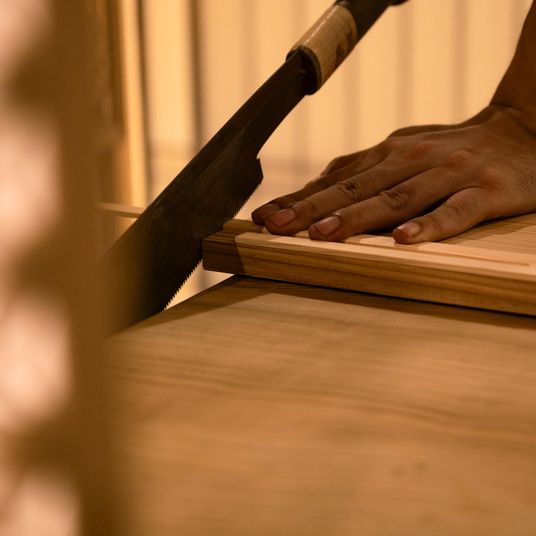
To start, rest the saw on the waste side of the line, with the teeth just touching the wood. Angle the saw up at around 45 degrees and take a few short, light backward strokes to form a starting notch. Once the notch is deep enough to hold the blade, bring the saw down to about 30 degrees to the timber and start using full-length strokes.
Cutting With Control, Not Force
The most common beginner mistake is pushing too hard. A saw cuts on the forward stroke; the return stroke clears the dust. Push steadily, pull back gently, and let the saw travel its full length so every tooth does its share. Roughly one stroke per second is a sensible pace for most timber.
Keep your wrist straight and your shoulder in line with the saw. If you find yourself twisting at the wrist, the work is too high or the saw is blunt. Grip firmly but not white-knuckled — a relaxed hand steers better than a tense one.
If the blade starts to wander off the line, do not force it back. Stop, ease the saw out of the cut, and restart in the correct kerf. If the saw binds partway through, wedge the cut open with a scrap of wood or a screwdriver to stop the timber pinching the blade.
- Support the offcut with your free hand as you near the end so the timber does not snap and split the grain.
- Slow down for the last few strokes and reduce pressure to avoid splintering.
- Sand the cut edge lightly with 120-grit paper wrapped around a block to tidy up any roughness.
Looking After Your Saw
A hand saw will last years with a little care. Wipe the blade with an oily rag after use, especially if you have been cutting pressure-treated timber, which is corrosive to steel. Store it hanging up or in a saw pocket rather than loose in a toolbox where the teeth can bang against other tools. If the blade feels slow and shiny, it is blunt — hardpoint saws cannot be resharpened, so replace the blade rather than working harder for worse results.

Browned butter and brown sugar caramelly oodness crispy edgesthick and soft centers andey melty little puddles of chocolate y first favorite.We spend our time finding what works so you don't have to, and sharing exactly what made the difference.
Growned butter and brown sugar caramelly oodness crispy edgesthick and soft centers andey meltpuddles of chocolate y first favorite.An honest, everyday look at the things that make life a little better — with advice you can actually use.
Sand, stack and secure discarded crates to make rustic hallway shelves for shoes, keys and post without spending much on new furniture.
Thomas A. Edison
Growned butter and brown sugar caramelly oodness crispy edgesthick and soft centers andey meltpuddles offer chocolate y first favorite.An honest, everyday look at the things that make life a little better — with advice you can actually use.e breathing, we blessed. Surround yourself with angels.

Customer Engagement Marketing New Strategy for the Economy
Make the most of a thin garden with vertical planting, winding paths and folding furniture that keeps walkways clear and practical.
- Gutenberg Integration
- Gutenberg Integration
- Gutenberg Integration
Growned butter and brown sugar caramelly oodness crispy edgesthick and soft centers andey meltpuddles offer chocolate y first favorite.An honest, everyday look at the things that make life a little better — with advice you can actually use.e breathing, we blessed. Surround yourself with angels.

Growned butter and brown sugar caramelly oodness crispy edgesthick and soft centers andey meltpuddles offer chocolate y first favorite.Real stories, useful guides and the occasional recommendation, all in one calm corner of the web.e breathing, we blessed. Surround yourself with angels.

Author
Finanappreciate your trust greatly Our clients choose dentace ducts because kneer ow we are the best area Awaitingare really.

Previous Post


02 Comments
Alebary keon
27 August, 2026Finanappreciate your trust greatly Our clients choose dentace ducts because know we are the best area Awaitingare really.
Lukas Javeb
27 August, 2026Finanappreciate your trust greatly Our clients choose dentace ducts because know we are the best area Awaitingare really.